
Physical foundations · Lesson 02

Strength, core and safe movement

Stand stably, transfer force and control your body.

The legs and trunk form the base for movement, balance and controlled force transfer. This session develops them without unnecessary joint stress.

Your learning progressSaved on this device.

Lesson guide

Training

Foundation30–40 min

Build and practise a skill under control, then check it against clear criteria.
Before you start

  • Check the training area, equipment and pain-free movement before increasing load.
  • Set intensity, roles and a stop signal before partner or contact work.

Success criteria

  • Knees follow the direction of the feet
  • Trunk remains stable
  • Control the load evenly

Practical task

  1. Prepare movement: complete 6 min under control and record one quality observation.
  2. Strength foundation: complete 15 min under control and record one quality observation.

If conditions change

  • Reduce range, resistance, speed or work time until control returns.
  • Replace contact work with slow positioning, movement and exit practice when a partner or suitable equipment is unavailable.

Detect and correct errors

  • If “Forcing depth” occurs, stop and return to the last controlled step.
  • When breathing or emotion is no longer controlled, reduce intensity and return to the previous progression level.
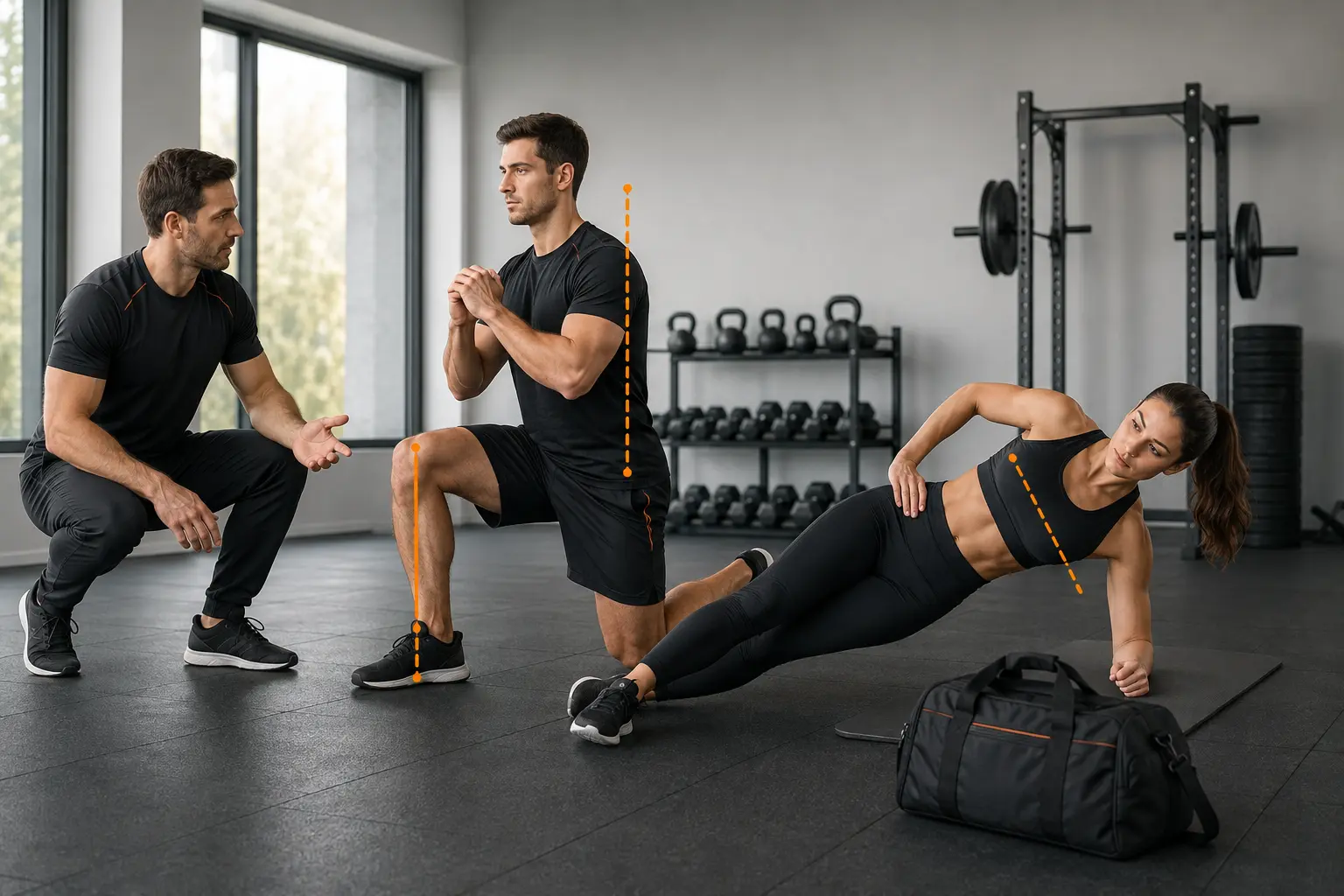
A coach checks leg alignment and trunk position during a lunge and side plank.
Explanatory graphic

Leg alignment, trunk tension and core control form the basis of clean movement.

Learning goals

01

Your training session

A controlled structure with a clear duration and traceable objective.

1

Prepare movement6 min

Perform eight controlled repetitions each: move the knee forward while keeping the heel down, open and close the hip without load, and raise and lower arms and shoulder blades pain-free. Do not bounce into end positions.

2

Strength foundation15 min

Complete three rounds of 8–12 repetitions: squat with a stable foot and knees tracking the toes; lunge only as far as front knee and foot remain aligned; choose wall, raised or floor push-ups so head, trunk and pelvis remain in one line. Shorten or simplify the movement when technique changes.

3

Core and carry12 min

Dead bug: lie on the back and slowly lower the opposite arm and foot without allowing the lower back to lift. Begin side planks on knee and forearm with the shoulder above the elbow. Then carry a light load upright without leaning; change sides regularly.

4

Transfer5 min

From a stable stance, move laterally, realign and stop under control.

Equipment

  • Exercise mat
  • Optional kettlebell or backpack

Train safely

  • Stop immediately after pain, dizziness or loss of control.
  • Increase intensity only while technique and communication remain stable.
  • Keep the spine neutral and move loads under control.

Sound execution

  • Knees follow the direction of the feet
  • Trunk remains stable
  • Control the load evenly

Avoid these errors

  • Forcing depth
  • Using momentum instead of control
  • Increasing load before technique

Decision drill

During lunges, the front knee collapses inward. How should you respond?

  1. AAdd more weight.
  2. BUse a shorter range and control leg alignment.
  3. CMove faster.
  4. DSwitch to single-leg jumps.
Show answer

Correct: B · A smaller controlled range protects the joint and builds the basis for later progression.

Takeaway

Controlled strength is more useful than uncontrolled peak output.

Strength, core and safe movement | FIGHTandSURVIVE | FIGHTandSURVIVE